


A basic COSY path program is a collection of paths in and parentheses. A path is an expression, similar to a regular expression built from event names, semicolons, commas, conventional parentheses and Kleene stars, enclosed by and parentheses. For instance:
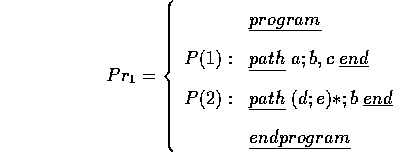
In every expression as described above, the semicolon specifies sequential occurrences of the events named or subexpressions, and comma specifies a mutually exclusive occurrence of one of the events named or subexpressions. The comma binds more strongly than the semicolon, so that the expression ``a;b,c'' means ``first event a must occur, after which exclusively either event b or event c must occur''. An expression may be enclosed in conventional parentheses with Kleene star appended, as for instance ``(d;e)*'' which means that the enclosed specification applies zero or more times.
Formally, a basic COSY path program is a string derived from the production
rules given below. The following meta-linguistic conventions have been used
in stating the syntactic rules. The symbols ``='',``  '',``
'',``  '',``|'',
``
'',``|'',
``  '',``
'',``  '', are used as meta-symbols. The symbol ``=''
indicates replacement of its left hand side by the string on its right hand side.
The braces ``
'', are used as meta-symbols. The symbol ``=''
indicates replacement of its left hand side by the string on its right hand side.
The braces ``  '' are
used to group items together, ``|'' indicates alternative productions,
``
'' are
used to group items together, ``|'' indicates alternative productions,
``  '' indicates production of ``item'' zero or more times,
and
``
'' indicates production of ``item'' zero or more times,
and
``  '' indicates production of ``item'' one or more times([JL92]p.19-p.20).
The syntax of a basic COSY path program is given by the following rules:










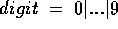
Similarly, the syntax of a basic COSY program is given by the following rules:


The standard formal semantics of path programs was expressed by means of vectors of strings. The collection of paths and processes determines a set of vectors of strings of operations. Vectors of strings of operations may be considered as a labelled partial order of operations, modelling a non-sequential behaviour of operation executions, and for this reason they have been called Vector Firing Sequences (VFS). Vector firing sequences may be shown to have the same modelling power as more conventional models for concurrent behaviour, such as occurrence graphs but have the advantage that they may be manipulated in the same manner as strings. The vector firing sequence semantics does not reduce concurrency to arbitrary interleaving and provides a mathematical environment for the formal definition of system properties and for the analysis of programs, determining whether the system they specify possesses such properties.
The following example is a specification of simplified real non-sequential
system. It consists of a linereader and
lineprinter communicating accross a ring buffer. We also provide the system
with an interrupt handler. What this does is to register an error message
arriving from
somewhere, halts the whole system and then restarts it again. We might picture
the situation as one in which both the registering of an error and the
restarting of the system results from an intervention from the system's
environment, say a human operator. The path program  which specifies
this system is presented in Figure 2.1, where event names stand for
their meanings.[JL92]p.133.
which specifies
this system is presented in Figure 2.1, where event names stand for
their meanings.[JL92]p.133.
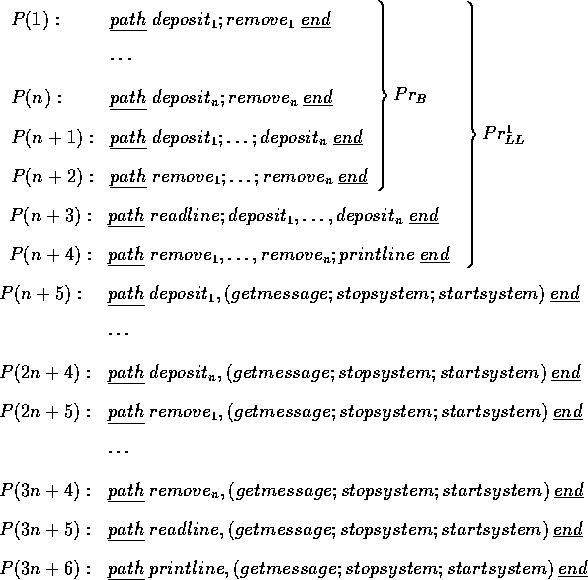
Figure 2.1: Reader and printer with n-frame ring buffer and
interrupt handler
In order to show the system more clearly, we suppose n has the value 5.
Therefore, the system will become  which is shown in Figure 2.2.
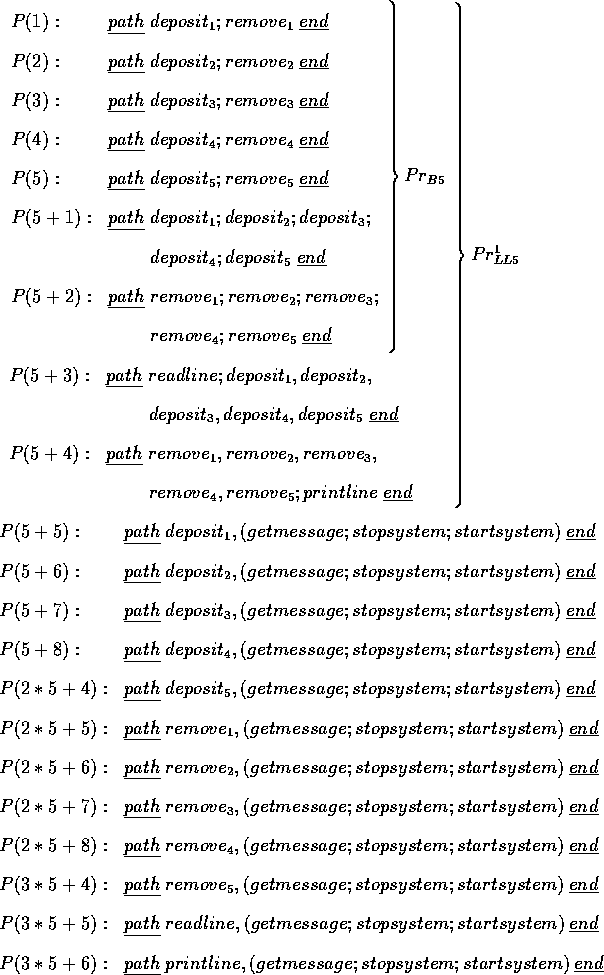
Figure 2.2: Reader and printer with 5-frame ring buffer and
interrupt handler
The part of called  describes the ring buffer with 5 frames. We suppose that we are not concerned with the actual content of the buffer at any time. Given this, the only operations associated with it are deposits and removes involving the various frames. Assuming that all the frames are empty initially, the desired pattern of behaviour of an individual
frame must be a sequence of alternating deposits and removes beginning with a deposit. This constraint is expressed by the paths
describes the ring buffer with 5 frames. We suppose that we are not concerned with the actual content of the buffer at any time. Given this, the only operations associated with it are deposits and removes involving the various frames. Assuming that all the frames are empty initially, the desired pattern of behaviour of an individual
frame must be a sequence of alternating deposits and removes beginning with a deposit. This constraint is expressed by the paths 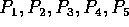 for frames 1,2,3,4,5, respectively. The paths
  and
and  impose
a ring discipline on deposits and removes. The path
impose
a ring discipline on deposits and removes. The path  expresses the constraint that after performing readline, the message (line) read must be deposited in one of the frames, and the path
  says that after removing a message (line) from any frame, the message must be printed by executing printline.
The paths
says that after removing a message (line) from any frame, the message must be printed by executing printline.
The paths  to
to  express the fact that the system may be
interrupted and restarted after any event.
express the fact that the system may be
interrupted and restarted after any event.
In order to express long basic COSY programs in a succinct and structured way, we introduce the macro COSY notation in the following section.