


The macro notation permits declarations of collective names corresponding to rectangular arrays and to arrays of other shapes.
When declaring rectangular arrays two conventions have been followed: either the lower bound of indices in their dimensions are implicitly considered as having the value one, or the lower bound is explicitly specified.
To shorten some otherwise lengthy expressions in our macro grammar we shall adopt the following convention:

The syntax for collectivisors is given by:
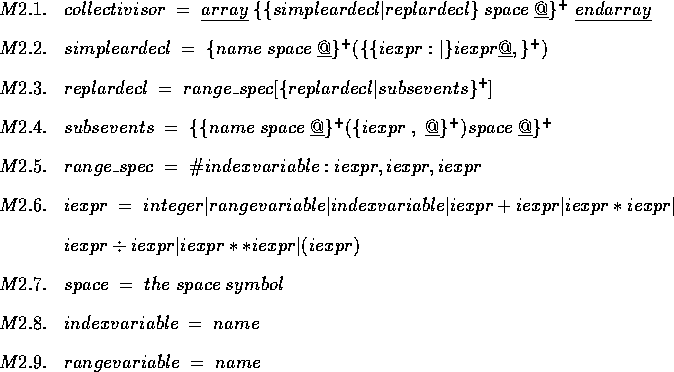
In the syntax rules given above, simpleardecl stands for a list
of collective names which correspond to simple rectangular arrays
together with their bounds, and replardecl stands for the
replicator generating admissible
sets of subscripted events. The non-terminal  stands
for the range specification part of a replicator,
iexpr for an integer expression, and subsevents for
a sequence of subscripted events.
stands
for the range specification part of a replicator,
iexpr for an integer expression, and subsevents for
a sequence of subscripted events.
When subscripts in the dimensions of arrays are consecutive
positive integers starting from 1, the lower bound in these
dimensions may be implicitly assumed to have the value one and only
the upper bound has to be specified.
We permit collective names with a different number of dimensions
and/or
different bounds in their dimensions to be declared by the same
collectivisor.
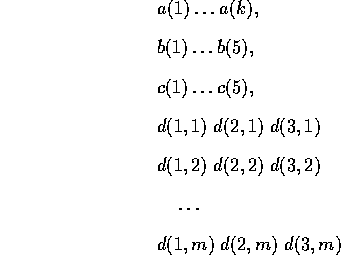
For example the two simple array declarations in C1:

declare the subscripted events:
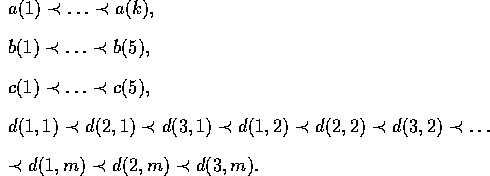
Furthermore the following total orderings are defined:
If the lower bound in some dimensions of collective names is not 1 but some other fixed integer n we may specify it explicitly. To specify for example that the single dimension of collective name e has lower bound n and upperbound k, and that the first dimension of the two dimensional collective name f has lower bound m and upper bound n and its second dimension lower bound 1 and upper bound k, we write the simple array declarations:

We also permit declaration of subscripted events the indices of which are not consecutive integers, or depend on the index of some other dimension, by means of replicator array declarations. For example, the index in the first dimension of the subscripted events:
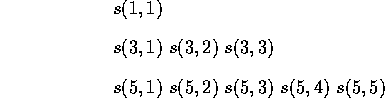
takes values 1,3,5 and the index in their second dimension takes consecutive values from 1 to the current value of the index of their first dimension. We shall use replicators to generate the set of admissible subscripted events. The subscripted events corresponding to s may be declared by the collectivisor C3:

using replicators.
All the declarations of the collectivisors must satisfy the restrictions Crest1, Crest2 and Crest3 which are given as follows:
All the Identifiers used for replicator indices must satisfy the index restrictions Irest1 and Irest2 which are given as follows:
 of the replicators with which they are associated. In
the scope of a replicator index variable no other replicator index
variable having the same name is permitted.
of the replicators with which they are associated. In
the scope of a replicator index variable no other replicator index
variable having the same name is permitted.