


Unlike the old expander, the new expander cannot expand the distributors directly because the distributor is represented by a subtree instead of a substring. According to the Theorem 3.4 (given in [JL92]p.267), every distributor can be replaced by a concatenator. So, we need to create a function called transform in order to transform all distributor subtrees into concatenator subtrees before expansion.
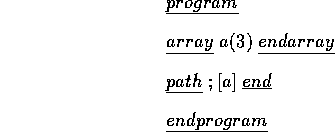
For example, we declare an array as following:

If the distributor has the form ;[a], we have the following steps to transform it into a concatenator:

Let's consider the other example, we have the distributor:

where the outer-most separator ``;'' is ``1'', the middle separator ``,'' is ``2'', the last separator ``;'' is ``3''. So, we will have the concatenator:

If the distributor has the form ;1[,[;[b]]], we will change it as follows:

If the distributor has the form 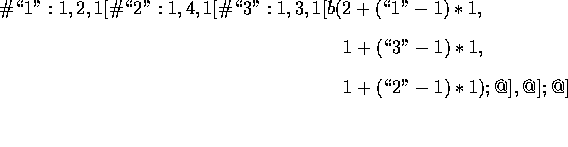 , we will change it as
follows:
, we will change it as
follows:

If the distributor has the form  , we will change it as
follows:
, we will change it as
follows:

We will discuss the function transform later. Now let's see how the syntax tree is changed after transformation. For instance, if we have a Macro COSY program as follows:

After parsing, we have the syntax tree as follows:
  Program
    (Programbody4
     (Array
      (Arraybody1
       (Simpleardecl
        (Name1 (Name "a"),Simpleardeclbody1 (Iexpr1 (Integer 3))))),
      Programbody1
       (Path
        (Sequence1
         (Orelement1
          (Gelement3
           (Distributor4
            (Simicol ";",
             Sequence1
              (Orelement1
               (Gelement1
                (Nostar
                 (Element (Event2 (Name "a"))))))))))))))
After transformation, the distributor is changed to a concatenator:
  Program
    (Programbody4
     (Array
      (Arraybody1
       (Simpleardecl
        (Name1 (Name "a"),Simpleardeclbody1 (Iexpr1 (Integer 3))))),
      Programbody1
       (Path
         (Orelement1
          (Gelement2
           (Sreplicator1
            (Range_spec
             (Indexvariable (Name "1"),Iexpr1 (Integer 1),
              Iexpr1 (Integer 3),Iexpr1 (Integer 1)),
             Concseq
              (Sequence1
               (Orelement1
                (Gelement1
                 (Nostar
                  (Element
                   (Event3
                    (Name "a",
                     Meventbody1
                      (Plus
                       (Iexpr1 (Integer 1),
                        Iexpr4
                         (Mult
                          (Iexpr4
                           (Plus
                            (Iexpr2
                             (Rangevariable
                              (Name
                               "1")),
                               Iexpr4
                                (Iexpr1
                                 (Integer
                                  ~1)))),
                                  Iexpr1
                                   (Integer
                                    1))))))))))), Simicol ";")))))))))
Now, we need to prove the new expansion is equivalent to the old expansion:
where parser is a function which translates the Macro COSY program from a
string to a syntax tree according to the Macro COSY grammar, pathfirst is
a function which puts all the paths in front of the processes, transform is a
function which transforms all distributor subtrees into replicator subtrees,
csr is a function which checks whether the syntax tree satisfies all
context-sensitive restrictions,  is a function which
expands the syntax tree into a string which is in the form of the Basic COSY
program,
is a function which
expands the syntax tree into a string which is in the form of the Basic COSY
program,  is a function which expands a Macro COSY program
from a string into a string which is in the form of the Basic COSY program,
o denotes a composition of two functions.
is a function which expands a Macro COSY program
from a string into a string which is in the form of the Basic COSY program,
o denotes a composition of two functions.